SRI LANKA
If you look at the map of Sri Lanka, you will catch its peculiar pear-shaped contours. Most beautifully, it is described as a teardrop of India also. Its shape resembles a teardrop falling from the southern tip of India.
Sri Lanka attained freedom in 1948 from British rule. Three ethnic groups Sinhalese, Tamil, and Muslims occupy almost 99 percent of the population of 22 million. Sri Lanka produces around 300 million kilograms of tea annually. Prior to the present economic catstrophe, it hits the world headlines due to Bombblasts by ISIS on Easter day across the country in 2019, which killed 255 people and injured more than 500, adversely affecting its tourism. Earlier, a long duration civil war with LTTE ( Liberation Tigers of Tamil Elam) for nearly 26 years weakened Sri Lanka.
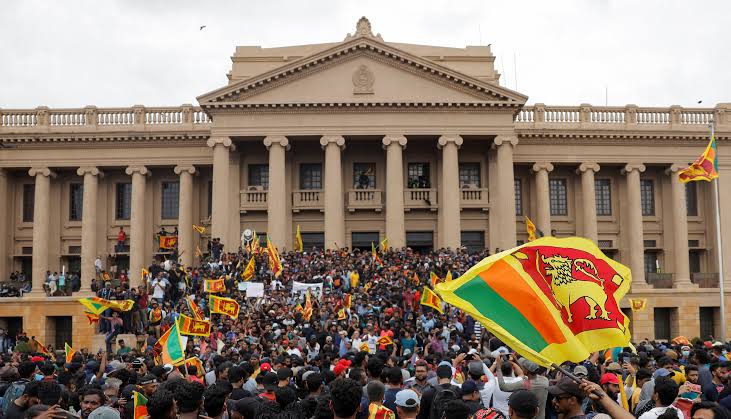
President of Sri Lanka Gotabaya Rajapaksa fled the country to Maldives first and now requesting Maldives to arrange a private jet to fly to Singapore. He left his country to save himself from the angry people of Sri Lanka. People are angry as wrong economic policies and mismanagement propelled Sri Lanka into an unprecedented economic crisis, and the sufferers are the common people of Sri Lanka. There is a severe shortage of food and fuel, and the prices of essential commodities are skyrocketed. Agitating mob thronged the palatial houses of President and Prime Minister demanding their resignation. The president’s resignation is yet to come. Meanwhile, all other political parties of Sri Lanka held a meeting and gave responsibility to parliament spaeker to act as president. As the protests intensified, the present Prime Minister Ranil Wikremsinghe clamped a curfew to be reoveked afterward. It’s a lesson for the world about how the representatives for the well-being of people to run the country should be elected.
Key contributors to Sri Lankan crisis
External DEBT service payment for Sri Lanka stood at 7 billion US dollars against 1.9 billion US dollars foreign reserves.
favorable Loan conditions as the country graduated to low middle income country
Roots go back to the early 2000s when the World Bank promoted the nation from a low income country to a low middle income country. A large share of the foreign debt came through concessionary funding from multilateral organizations such as the World Bank, Japan international cooperation agency and the Asian development bank – ADB and with favorable loan conditions such as low interest rates of 1 percent and longer periods for its repayment -25 to 40 years. It assisted in the systematic management of foreign exchange reserves.
As the nation became a middle income county, the access to concessionary funding became scarce, and the Sri Lankan economy shifted towards an increasing proportion of commercial loans in the form of international Sovereign bonds – ISBs instruments of capital market borrowings and carried higher interest rates to above six percent with shorter durations of repayment – 5 to 10 years and no grace period.
Commercial Borrowings without paying attention to structural weaknesses
ORF (Observer Research Foundation, an independent global think tank based in New Delhi, India) says that it is fair to say that the ever increasing foreign debt obligations for Sri Lanka have been a major contributor to the present economic woes. Sri Lanka relied on commercial borrowings without paying heed to the structural weaknesses in the economy. Structural weaknesses such as decreased trade levels as a percentage of GDP (from 33 percent in 2000 to 13 percent in 2019), low levels of FDI and tax revenues that have been falling over time, amongst others- have devastated the economy in an impactful manner.
Sri Lanka’s excessive foreign borrowing in exchange for infrastructure projects that have failed to provide high returns. Increasing external debt servicing overwhelmed an already weak economy that was left faltering from the economic costs of the 26 year long civil war that came to an end in 2009 and was followed by the repercussions of the global financial crisis in 2007-8 alongside continual fiscal and current account deficits.
Failure to invest in major industries,education or training and adherence to old trade practises
Print.in says that it is really strange about it is the lack of basic planning and foresight by the Rajapaksa Government to have gauged its enormity in time and initiate necessary corrective measures. Sri Lanka failed to invest in any major industries, 6 training, and held itself hostage to colonial era exports of garments, rubber, and tea. The reduced demand had a negative impact. The Easter bomb blasts in Colombo, which killed more than 250 people and killed the tourism industry. The effect on Sri Lanka’s economy was immediate and shock inducing. There was a reduction in income through tourists by around 20 percent, adversely affecting foreign exchange reserves.
Lowest Tax regime in the World destroying welfare and sectoral development schemes
In 2019, the Rajapaksa government offered huge cuts in value-added tax, corporate tax, and all categories of direct and indirect taxes. While it earned Sri Lanka the tag of being a country with one of the lowest tax regimes in the world, the rate cuts destroyed the govt’s ability to capitalize and invest in welfare, employment, sectoral development and other schemes. Tax collections plunged more than fifty percent in just one year alone 19-20. Revenue deficit increased. At the same time, the government also increased its expenditure substantially. This resulted in the budget deficit inereasing by more than 100 basis points. Covid 19 also affected Sri Lanka.Demand for Sri Lanka goods felled.
According to Monica Verma writing in News 18 – In 2019, newly elected Sri Lankan President Gotabaya Rajapaksa unveiled his grand vision for Sri Lanka,” Vistas of prosperity and splendor” within which he outlined a 10-year transition to fully organic farming in Sri Lanka.
Sudden Ban of artificial fertilizers neglecting consequences
What was shocking about it is that after the PM’s grand declaration, in a few months, all of a sudden, came another announcement of a complete ban on the import of chemical fertilizers and agrochemicals. The food grain production was lowered, resulting in inflation.
Chinese Angle
Economic Times says China ranks third among Sri Lanka’s creditors after Japan and the ADB and accounts for 10 percent of the debt. Foreign loans built highways, airports and convention halls in the jungles which did not give any in foreign currency, said a lawmaker, Kabir hashim “Now we don’t have the dollars to pay them back the dollar loans. Critics cite a Chinese built port in Hambantota in the southeast as a prime example of official recklessness. It was built in the hometown of then President Mahinda Rajapaksa and paid for with 1.1 billion dollars in Chinese loans despite the plan having been rejected by an expert panel. Its promoters said Hambantota,on busy Indian Ocean shipping routes, would ease the burden on Sri Lanka’s main port in Colombo. But it failed to generate foreign revenue.
Beijing bailed out the port in 2017 by having a state owned company , China Merchants Group , buy a 99-year lease for 1.1 dollars billion. That includes land for an industrial plant. The deal gave Sri Lanka cash to repay Chinese banks but prompted accusations of official bungling gave a foreign government. control of the port of the country. Chinese loans also paid for an international airport near Hambantota. Few airlines use it.
Fuel scarcity due to Russian invasion of Ukraine.
Sri Lanka can not escape the impact of the Russian invasion of Ukraine on the fuel supply. It added to all out inflation of all commodities and scarcity of fuel. It has affected common man with severe impact on working resources, resulting in slumping overall efficiency and commuting. Educational institutes and government establishments were closed to ease the demand.
At last the ultimate sufferers – the people of Sri Lanka trying for their own welfare.
People of Sri Lanka turned into protesters and had to take reins in their hand to awaken the politicians of their slumber and needed, thrashed, wounded, and even killed politicians. Now, the terrified politicians are running and leaving their properties at the mercy of protesters who took control of even the presidential palace. They burned houses of politicians, attacked, and vandalized their offices.
With the shortage of food and fuel and prices spiraling high, the ruling elites are running for shelter and trying to save their skin and life from the angry mobs. But one must admit that there is honesty in the agitation and not even single news of vested interests reached here. The cash found in Rajapaksa’s palace, which was not a small sum in the tune of 17.85 million rupees was returned and now in the custody of a Colombo court bears testimony to the psyche of the protesters.
People’s power allowing nobody to escape their responsibilities
The protesting mob occupying presidential palace and government buildings was astonished at the lavishness and luxury enjoyed by politicians on the taxpayers’ money. Gotabaya Rajapaksa wanted to flee to Dubai, and he had to face a standoff at the airport. Immigration officers at the airport refused to stamp his passport by going to his suite. He does not wish to go through public facilities fearing reprisal from other commuters at the airport. He stayed at the fortified houses and missed three flights overnight, and told how frightened he was. He is ready to resign, ready to abandon all his political ambitions, and wants to save his life. Had he been sensitive enough to administer wisely, he would not have to face such threats to his life.
His youngest brother Basil was finance minister who resigned in April and also faced a standoff at the airport. He also wanted to run from his country. When he tried to travel as a business traveler, other passengers protested against his boarding the same plane. Looking at the angry passengers and their increasingly hostile reactions, he hurriedly left the airport and saved himself.
Nepotism
It seems that many of the Rajapaksas have their escape plans ready as they have dual citizenship of the US. Favors and Nepotism was rampant as Gotabaya Rajapaksa – President, Mahinda Rajapaksa – Prime Minister, Chamal, Basil, Namal, Shashindra all enjoyed high posts and powerful portfolios in the ruling cabinet. Even the chief of staff to Prime Minister was of Rajapaksa family. Indeed, nepotism was very high.
Hambantota , the native place of Rajapaksa, wears a mocking testimony to the whims of the ruling elites. It has an international airport in their name, which is devoid of passenger flights. A dock developed with Chinese money hardly sees any ship docking there and a huge cricket stadium waiting for a match.
As per the latest news, Rajapaksa family members have already succeeded in leaving Sri Lanka. Gotabaya Rajapaksa landed in Maldives. Emergency is declared in Colombo, and all became very, very uncertain.
Importance of literacy of masses and real use of democracy to elect carefully
 the-curators.org
Leave a comment