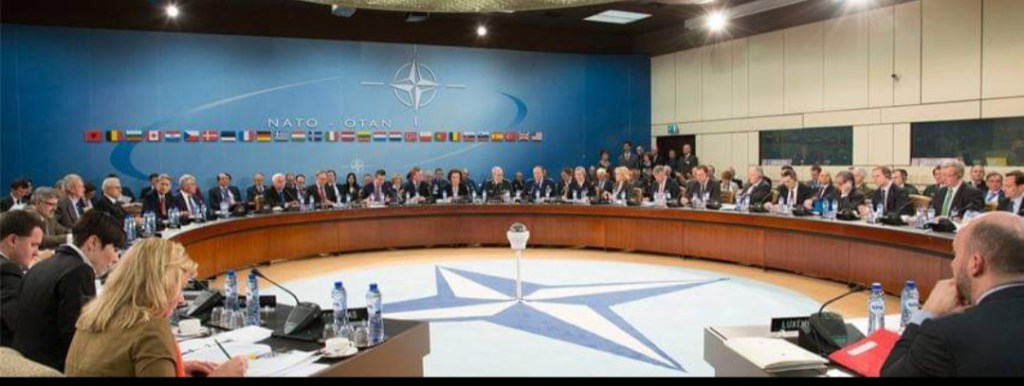
NATO is 75 years old! The genesis of NATO can be traced back to the Marshall plan created by George Marshall, then US Secretary of State for economic recovery of a war devastated Europe. This plan later on extended into Brussels Treaty of 1948 signed by the US, Great Britain, France, Belgium, the Netherlands, and Luxembourg.
This plan has further promoted the idea of combined defense and cooperation between the US and Western Europe. These events acted as precursors to NATO. The founding North Atlantic Treaty which was signed on 4 April 1949.
The combined defense strategy helped Western European countries to focus on growth without large defense expenses. NATO was necessary to stop an aggressive Soviet Russia propagating communism and was particularly strong in East Europe.
The adoption of the strategic doctrine of ‘massive retaliation’ with the use of nuclear weapons if the Soviet attacks, even in small measure, helped West Europe enjoy peace. NATO shielded Europe impressively.
There are 32 countries as members of NATO, and they are 1.Albania 2.Belgium 3.Bulgaria 4.Canada 5.Croatia 6.Czechia 7.Dennark 8.Estonia 9.Finland 10.France 11.Germany 12.Greece 13.Hungary 14.Iceland 15. Italy 16.Latvia 17.Lithuania 18.Luxembourg 19.Montenegro 20.Netherlands 21.North Macedonia 22.Norway 23.Poland 24.Portugal 25.Romania 26.Slovakia 27.Slovenia 28.Spain 29.Sweden 30.Turkiye 31.United Kingdom 32.United States.
According to the official website of NATO, the alliance creation was part of a broader effort to serve three purposes – 1.Deterring Soviet expansionism 2. Foreboding the revival of nationalist militarism in Europe through a strong North American presence on the continent, and 3.Encouraging European political integration.
Though NATO forbade nations of reviving militancy, many countries in Europe are now openly showing rightist inclination and are required to increase spending on defense on NATO’s directive.
NATO’S modernization in the latest technology is trying to provide cyber security but falls short of expectations when Russian hackers broke into the US elections, network of Germany, and cyber network of many other countries. However, it’s to the credit of NATO that arms race and nuclear threat in Europe remain under control.
NATO’s policy of attack on one member considered as attack on all members provided collective security to members. Approval of all member countries is needed to admit a new country into NATO which made new country’s admittance a collective responsibility. NATO’S adaptability to situations is seen from time to time. France opted out and then returned back to NATO without aggravating situation. Turkey demanded extradition of Kurd freedom fighters from Sweden and Finland and refused approval to induct into NATO. NATO amicably settled the issue. But the 2019 Syrian invasion by Turkey raised concerns about NATO unity.
NATO, in a way, West’s, and more particularly of US’ answer and main weapon to complex international crises. And, in the current challenging situation, NATO would escalate the war by deep attacks (before further polarization) on Russia’s strategic centers using Ukraine – shield and shielding Ukraine, too! The military preparations, readiness, increasing defense expenditure, F-16s to Ukraine, and modernizing nuclear deterrent all point out to combat readiness and a war plan.
The Soviet Fall in the 1990s set a horde among the East European countries to turn democratic and reject communism made NATO complacent.
Those times witnessed irregular and hampered Western aid worsening the derailed Yugoslavian economy that weakened the control of Belgrade over the confederation, having a mix of ethnic groups and religions mainly of Orthodox Christianity, Catholicism and Islam.
The unstable conditions fueled the Serbian separatist movement, propelling the entire region into anarchy and racial war. The slackened attention and mishandling saw millions displaced and hundreds and thousands dead with total disintegration of Yugoslavia.
NATO deployed soldiers and brutally bombed the sovereign country for 11 weeks, targeting the Serbian army and infrastructure without the permission of the UN. US and NATO have time to time disregarded UN and its resolutions, and that is perhaps what Israel too is repeating now!
The lengthy Afghanistan crisis too, saw West and NATO struggled to control. Even though NATO, and allied forces succeeded in overthrowing Taliban regiment and killing Osama Bin Laden, they can not establish democracy and peace on Afghanistan soil.
And, Libya too remained unstable, falling in the hands of unruly and opposing rebel groups though the Gaddafi regime was toppled. NATO and the US fail to bring democracy there. However, what NATO critiques think that the NATO’s role was over with the end of Soviet Russia is not totally correct.
It was the NATO deterrence that kept Russia in check and presently prevented the Ukraine war from spilling over into Europe. its successful new inclusions of Sweden and Finland encircled Russia, further isolating it and contributing to European safety.
Ukraine’s persistence to become an EU and NATO member is one of the main cause of the Russian invasion along with rather a timid Western response when Crimea was taken over by Russia. At the start of the Ukraine war, Russia clearly stated that let NATO officially refuse further expansion and close its doors ( for new membership)
In the recently concluded Washington summit, NATO almost declared a war on Russia. NATO’s reiteration of complete support to Ukraine, aid of 40 billion Euros, and weaponry with establishing NATO Security Assistance and Training for Ukraine would slow down Russian advance.
China was admonished sternly and accused as ‘enabler of Russian war in Europe’. The summit asked member countries to ramp up industrial production and modernize nuclear deterrent.
The Russian threat has succeeded in spending 2 percent or more of GDP by not a few member countries but by 23 countries. In the near future, this might convert into an arms race.
NATO is spreading its reach and reaching for Indo-Pacific partners like Australia, Japan, South Korea, and New Zealand. NATO economics revolves around the US, and it is no surprise as the US economy exceeds half of NATO’S economic output, so ( US contributions to NATO)just over 50 percent of Western security assistance.
Russia is watching NATO preparations closely. Dmitry Peskov said, “We see NATO’s decision to create logistic hubs in Black Sea cities and open additional points in Europe. NATO’S military infrastructure is progressively moving towards our borders,”
As the war is lengthening the international focus, particularly from other continents, is drying up. And, the awareness to be together is seemingly increasing in the West.
There were elections in the EU and NATO. shoulders changed or continued depending on the past load they carried. Mark Rutte will take over from Jean Stoltenberg as the new Secretary General of NATO from October 2024. Rifts, too, are visible stemming from the past associations, from dependency, need, and politics.
The energy demand is increasing, and it has started to play a ‘from behind the curtain’ play. Hungary has present European Union Council Presidency till December 2024 (During these 6 months, ministers from that country’s government chair and help determine the agenda of Council meetings in the different policy areas, and facilitate dialogue with the other EU institutions). And, the Hungarian Prime Minister Viktor Orban visited Putin, Xi Jin Ping, and Trump, too. Trump’s remark that he can end the war in a day’s time made NATO members apprehensive and uneasy.
Ukraine prohibited transport of Russian fuel to Hungary, Czech Republic, and Slovakia. The Druzhba pipeline transports crude from Lukoil to Hungary, Slovakia, and the Czech Republic through Ukraine.
What Russia plays with the energy card and what the dependent states will follow can be a headache for NATO. With a visibly instigated China, Cunning Russia, ( Their joint military exercise in Belarus close to Ukraine boundaries) international outcry against Israel uniting the Muslim world, Cyber security, US elections, Indo-Pacific challenge, and future US foreign policy if former president Trump comes to power in the US will keep NATO busy indeed!
 the-curators.org
Leave a comment