Just Rhetoric or Real:
1. Turkey President Erdogan threatened to invade Israel
2.Israeli Foreign Minister Israel Katz likened this with what happened of Saddam Hussein (and his fate)
3.Turkey Foreign Ministry now compared Netanyahu with Hitler .
Links below⬇️
US, JAPAN, AUSTRALIA AND INDIA FOREIGN MINISTERS MEET IN THE MEETING OF ‘QUAD’ IN TOKYO, JAPAN
US Secretary of State Antony Blinken, Yoko Kamikawa, Foreign Minister of Japan, Penny Wong, Foreign Minister of Australia and S.Jaishankar, External Affairs Minister,India. As we know, these four countries, the US, Japan, Australia, and India, formed the quadrilateral Security Group QUAD.
A link is provided below to know everything about the QUAD – FROM Archives.
Archives 8 ‘QUAD : The Origins.
SUNDAY, MARCH 28, 2021
QUAD
The terrible tsunami that rose from the mighty Indian Ocean after a terrific earthquake in 2004 wreaked havoc by killing and displacing hundreds and thousands of human lives.
India started a massive relief and rescue operation on her shores and for the affected countries. Soon, the navies of Japan, Australia, and the US joined the ensuing disaster relief operations. The group was disbanded afterward, but the group nations were impressed and convinced of its usefulness and effectiveness.
The quadrilateral formation provided more stimuli for maritime cooperation and regional concerns, and thus, the QUAD was born. Though the origins of the quad are in the cooperation and aid in the times of crisis of a colossal natural calamity, its fumbled revival is rooted in geopolitical and trade & commerce reasons with a promise of a fair humanitarian and climate conservative act.
The Indian role assumes great significance as the activities of the group will be in its backyard, and it is the only country in the group sharing a huge land border of 3488 kilometers with China. As of India’s original character, it must not let the group don a militarized avatar of an economic, political, and environmental exploiter.
The Japanese Prime Minister Shinzo Abe must be credited for the revival of QUAD. He elegantly muted the proposal in his famous speech of ‘Confluence of two Seas’ at the Indian Parliament. It was August 22, 2007. The Japanese prime minister said,
“The Pacific and the Indian Oceans are now bringing about a dynamic coupling as Seas of freedom and prosperity. ‘A broad Asia’ that broke away from geographical boundaries is now beginning to take on a distinct form”.
“Our 2 countries have the ability – & the responsibility – to ensure that it
broadens yet further and to nurture and enrich these Seas to become Seas of clearest transparency”.
“By Japan and India coming together in this way, this ‘broader Asia’ will evolve into an immense network spanning the entirety of the Pacific Ocean, incorporating the US and Australia. Open and transparent, this network will allow people, goods, capital, and knowledge to flow freely”.
“In addition, as maritime states, both India and Japan have vital interests in the security of Sea lanes, it goes without saying that the Sea lanes to which I refer are the shipping routes that are the most critical for the world economy”.
A joint statement issued afterward clearly reflects on the inclusion of other like-minded countries. The joint statement read like follows:
The two leaders welcomed the participation of the Japanese maritime self-defense force in the multilateral maritime exercise “Malabar” to be held in September 2007 in the Bay of Bengal. The two leaders shared the view on the usefulness of having dialogue among Japan, India, and other like-minded countries in the Asia-Pacific region on themes of mutual interest.
It is clear from the speech of Hon. Prime Minister of Japan and the joint statements issued afterward that the two country heads have envisioned a larger role and participation in their mind.
However, the things shaped afterward were very different. The geo-political standings were changing rapidly with rising China. Japan has clearly crafted a new mechanism in the form of QUAD to counter China’s growing assertion, but the other countries’ reluctance was palpable due to trade and commerce relations with China.
All 4 countries of QUAD were having China as their first or second partner in trade and commerce. China, on its part, took a sharp cognizance of QUAD and started to exert pressure. This has discouraged member countries from openly advocating QUAD.
A frustrating Japan couldn’t do anything but watch China’s growing assertion in the Indo-Pacific region. Another event that propelled QUAD backward was the resignation of Japanese Prime Minister Shinzo Abe in 2007.
From 2007 to 2017, foreign policies of the QUAD countries resonated with a common focus on securing a free and open Indo-Pacific region, terrorism, and a semblance of a rule-based system. The Chinese pressure impacted dealing in QUAD, and instead of quadrilateral dealings, bilateral or trilateral dealings started.
Before Shinzo abe visited India, international activities gathered momentum as US vice president Dick Cheney showed American interests in the QUAD dialogue. Australian prime minister Howard and Cheney interaction in early 2007, Tokyo meeting between Australia, Japan, and India resulted in the first meeting in May 2007. This meeting was held on the sidelines of the ASEAN Regional Forum meeting in Manila. The late September of that year saw the ‘Malabar Exercise’ with 4 QUAD nations’ navies with Singapore navy in the Bay of Bengal. These activities were closely monitored by China. The growing pressure from the Chinese restrained the QUAD countries but led to many bilateral and trilateral interactions.
India and the US signed Communications Compatibility and Security agreement in 2015.
Japan and India signed Civil Nuclear Cooperation Agreement in 2017
Japan became a permanent member of the Malabar naval exercise in 2015.
Japan joined the US-Australia military exercise of Talisman Sabre in 2019.
India and the US signed Logistic Exchange Memorandum of Agreement in 2016
India and Australia started AUSINDEX, a major biennial bilateral exercise in 2019.
Since 2007, China has become suspicious of the QUAD and tried to pressurize the countries involved in it.
The Chinese Global Times accused the US of transforming QUAD into a military organization just like NATO- ASIAN NATO. It blamed the US. Global Times wrote that the other 3 – India, Australia, and Japan have developed a realistic relationship with China’s economic growth. China asked all involved countries to explain if it was anti-Beijing in its direction. India assured then Chinese president Jintao that it’s not a security and defense concerning formation but more about a democratic experience sharing group.
Under Kevin Rudd of the Labor Party, Australia became a strong critic of QUAD and unilaterally pulled out of QUAD. With India and Australia treading cautiously, QUAD started to lose its shine. In 2007, then Australian Defense Minister Brendan Nelson, while visiting New Delhi, said that Australia would like QUAD limited to non-strategic issues like trade, culture, and issues outside of defense and security Indian Prime Minister Manmohan Singh also assured China that the QUAD carries no security implications. China was the major importer of Australian goods in those times.
The US was trying its best to engage Australia in the bilateral military or naval exercises, making strong relations with India and promoting Japan militarily. The US was also the biggest trading partner of China. Had it not been the Chinese international demeanor post-2015, then QUAD would have been dormant.
This was just a prelude to trade wars between the US and China. Economic prosperity, astonishing technological advancement, and the resulting flourishing trade and commerce of China fermented the international scene and caused many upheavals.
China’s international relations cannot escape the attention of western media and numerous articles appeared in journals, publications questioning Chinese motives in relations, rumors of a political donation, meddling in universities, debt-trap diplomacy, technological help for favors, its way with African, Latin American and European countries all increasingly came into play. The world started to look suspiciously at its initiatives like belt and road, the revival of Silk Route, and increasing complaints of neighboring countries of Sea and land intrusions.
The Chinese bullying of Taiwan was condemned. China blocked repeated attempts of India to be a member of the Nuclear Suppliers Group. China blocked a bid to Indian attempts to call Pakistani militant terrorists. Indo-Chinese borders became tense with ensuing stand-offs like the one experienced at Docklam tri-junction with Bhutan.
The China-Pakistan economic corridor passing through Pakistan occupied Kashmir made India-China relations strained. Australia experienced Chinese influence in politics and universities and has to resort to making laws about foreign participation in domestic affairs.
The US experienced economic espionage and theft of technology. Hi-tech interference in intellectual property copyrights and, of course, the struggle for world supremacy had changed the perceptions of the US.
Tensions between Japan and China increased when Japan nationalized Senakaku/Diaoyu islands in Okinawa Prefecture. The islands are northeast of Taiwan and are with abundant natural resources and near to sea trade routes.
Chinese incursions by Chinese Coast Guards and Chinese aircrafts further strained the relations.
In 2012, Shinzo Abe returned to power in Japan.
With increasing China’s technological advances, prospering trade and commerce, and political say, the contours of QUAD started to become sharp and visible.
The quadrilateral dialogue, which was initiated in 2007, rejuvenated in 2017 by then US Secretary of State Rex Tillerson and Finance Minister of Japan Taro Kono, they suggested the resumption of the quadrilateral dialogue format. Accordingly, the 4 nations Heads –
Prime Minister Narendra Modi of India, Prime Minister of Japan Shinzo Abe, Prime Minister of Australia Malcolm Turnbull, and US President Donald Trump agreed to give momentum to QUAD.
The representatives of the four nations meet on the sidelines of the ASEAN summit in Manila and discussed a multitude of issues, including a free and open Indo – Pacific region. Further to it, the communication continued, and in 2019, a ministerial-level meeting was conducted on the sidelines of the UN General Assembly in New York. Then US Secretary Mike Pompeo said in 2019 that We have reconvened the QUAD – the security talks between Japan, Australia, India, and the US that had been dormant for nine years.
Australia’s reluctance to be a QUAD country was due to its abundance of trade with China. In fact, it was one of the countries whose export to China was more than what is imported from China. Wine, coal, wood logs, poultry, and meat exported to China. The perception and balance of trade changed when the Chinese retaliation started after Australia’s inquiry call about the origins of coronavirus. The Chinese reacted with the ban and stopping imports of coal, wood logs, lamb, beef, lobsters, and other goods from Australia, and increased tariffs on Australian wine and barley. The Australians started to retaliate by strengthening its geopolitical position, rejoining the Malabar exercise, and as an active participant country in QUAD.
Japan has succeeded in sharing the burden of growing Chinese dominance in the Indo-Pacific region and simultaneously increasing trade opportunities – by persistently trying for QUAD to become an active reality.
Indian policymakers tried improvements in bilateral relations with China and tread the path of QUAD cautiously. Prime Minister Narendra visited China and hosted the Chinese president in India. India disallowed Australia’s Malabar exercise participation in 2017 to placate Chinese grievances about QUAD.
The apprehensions about border disputes continued to encompass the bilateral talks. The border incursions grew in numbers and converted into tense stand-offs. The transgressions across the disputed borders grew from 428 to 663 in 2019, and then the infamous standoff happened at Galwan Valley in Ladakh, where soldiers from both sides got killed. Chinese pearl of strings’ strategy of developing military alliances and assets around Indian subcontinent encircling India to control trade routes and as strategic naval warfare points also made India wary of its intention The Indian prime minister refused to sign the Regional Comprehensive Economic Partnership (RCEP) at the ADEAN summit in Bangkok, fearing Chinese imports could affect the manufacturing abilities of India. Chinese meddling into Nepalese affairs distanced Nepal from India. Chinese funding and investment had grown exponentially in Sri Lanka.
Projects like building up Colombo Port Terminal, signing of Hambantota Port Concession Agreement, increased Chinese strategic assets. The Chinese role in Myanmar in the form of the China-Myanmar Economic Corridor –CMEC and the silence maintained in the recent military coup in Myanmar also impacted Indian foreign policy. These factors may have contributed to the Indian resolve for QUAD.
The trade wars and the struggle for world supremacy already compelled the US to take the differences with China to its doorsteps. And, what better strategy is there from making the adjacent countries involved in the cause. The scope for QUAD may soon grow in number by the inclusion of like-minded countries.
France has already included QUAD members into its joint naval exercise “La Perouse”. France has an exclusive economic zone – EEZ, including territories in the Pacific and South Indian Ocean. Around 8000 French military personnel are stationed in the region. France is a member of the Indian Ocean Rim Association. The emergence of the Indo-Pacific region as a hotbed of future geopolitical activities increases the importance of QUAD. It is India’s responsibility to instill moderations in aggressive policies of QUAD. India should prevent any possibility of increasing the arms race in the region.
The Indo-Pacific region comprises of Australia, Bangladesh, Bhutan, Brunei, Cambodia, Fiji, India, Indonesia, Japan, Laos, Malaysia, Maldives, Myanmar, Nepal, New Zealand, Papua New Guinea, Philippines, Singapore, Sri Lanka, Taiwan, Thailand, Timor Leste, United States, Vietnam, etc. China is connected to the region as its seas and straits connect to the Indian and Pacific Oceans. With 65% of the world population in this area and 62% of the world GDP, it is not surprising that its importance is growing. There are numerous naval and military bases scattered across the region.
There are US bases from Hawaii to Diego Garcia, Djibouti, and Gram to Okinawa. China has already networked
from Djibouti to Myanmar. Japan is on the constant vigil of important sites in the region, and Djibouti has a Japanese naval base. Cocox and Christmas Islands are Australian outposts. Britain has a base at Diego Garcia. France has bases at Reunion and New Caledonia. India is building ports in Chittagong (Bangladesh), Colombo (Sri Lanka) and Sittwe (Myanmar), and Mauritius.
There are disputes between Indo-Pacific countries and China about territorial sovereignty over islands and smaller features in the South China Sea.
With all the background set and the aggressive posture adopted by China, the heads of four countries of QUAD came together and held the first virtual meeting. In times of pandemic, this is a historic event.
They penned a joint op-ed on March 13, 2021, in Washington Post- An American daily newspaper published in Washington D.C. It reflects the ideology, ambitions, and general direction QUAD intended. This proximity may increase further the arms race in the real sense, and may the area may assume the face of the next volatile region of the earth taking over from the gulf region.
From Washington Post
Opinion by Joe Biden, Narendra Modi, Scott Morrison, and Yoshihide Suga
Joe Biden is president of the United States. Narendra Mosi is the prime minister of India. Scott Morrison is the prime minister of Australia. Yoshihide Suga is the prime minister of Japan.
In December 2004, the continental shelf off the coast of Indonesia shifted two meters, creating one of the largest tidal waves in modern history and a nearly unprecedented humanitarian crisis around the Indian Ocean With millions displaced and hundreds of thousands killed, the Indo-Pacific region sounded a clarion call for help. Together, our four countries answered it.
Australia, India, Japan, and the United States – a group of democratic nations dedicated to delivering results through practical cooperation-coordinated rapid humanitarian assistance, and disasterrelief to people in need. Our cooperation, known as “the QUAD,” was born in crisis. It became a diplomatic dialogue in 2007 and was reborn in 2017.
Now, in this new age of interconnection and opportunity throughout the Indo-Pacific, we are again summoned to act together in support of a region in need.
Since the tsunami, climate change has grown more perilous, new technologies have revolutionized our daily lives, geopolitics has become ever more complex, and a pandemic has devastated the world.
Against this backdrop, we are recommitting to a shared vision for an Indo-Pacific region that is free, open, resilient, and inclusive. We are striving to ensure that the Indo-Pacific is accessible and dynamic, governed by international law and bedrock principles such as freedom of navigation and peaceful resolution of disputes and that all countries are able to make their own political choices, free from coercion.
In recent years, that vision has increasingly been tested. Those trials have only strengthened our resolve to reckon with the most urgent of global challenges together.
Our governments have worked closely for years, and Friday, for the first time in “Quad” history, we convened as leaders to advance meaningful cooperation at the highest level. To strengthen our quest for a region that is open and free, we have agreed to parent to address the challenges presented by new technologies and collaborate to set the norms and standards that govern the innovations of the future.
It is clear that climate change is both a strategic priority and an urgent global challenge, including for the Indo-Pacific region. That’s why we will work together and with others to strengthen the Paris agreement and enhance the climate actions of all nations. With an unwavering commitment to the health and safety of our people, we are determined to end the covid-19 pandemic because no country will be safe so long as the pandemic continues.
The pandemic is among the greatest risks to health and economic stability in recent history, and we must work in partnership to stop in its tracks. Now, we are launching an ambitious effort to help end covid-19, Together, we pledge to expand and accelerate production in India of safe, accessible, and effective vaccines.
We will partner at each stage to ensure that vaccines are administered throughout the Indo-Pacific region into 2022, We will combine our scientific ingenuity, financing, formidable productive capacity, and long history of global-health partnership to surge the supply of life-saving vaccines, in close collaboration with multilateral organizations including the World Health Organization and Covax Facility.
Our vaccine initiative will be guided by a Quad Vaccine Experts working Group that brings together the sharpest scientific leaders from Australia, India, Japan, and the United States to meet the region’s pressing needs. And, though the pandemic prevents us from meeting in person, we will do so before the end of 2021. The promises we make today must translate into a healthier and more prosperous Indo-Pacific tomorrow.
We are proud to announce these bold steps- and eager to begin the work our countries must undertake to achieve them. Ending and recovering from the pandemic, standing up to climate change, and advancing our shared regional vision will not be easy.
We know we cannot and will not succeed without coordination and cooperation. We will renew and strengthen our partnerships in Southeast Asia, starting with the Association For Southeast Asian Nations, working with the Pacific islands, and engaging the Indian ocean region to meet this moment. The QUAD is a flexible group of like-minded partners dedicated to advancing a common vision and ensuring peace and prosperity. We welcome and will seek opportunities to work with all of those who share in those goals.
Over the course of these past months, each of us has grieved the suffering that our people and the world have endured. But in this dark hour, our partnership offers a spark of hope to light the path ahead.
Our foundations of democracy and a commitment to engagement unite us. We know we can provide for the safety and prosperity of our people at home by confronting global crises together, with purpose and resolve. We summon from tragedy the strength and resilience to unify and overcome. And we recommit ourselves, once again, to an Indo-Pacific region that is free, open, secure, and prosperous.
The bold international initiative produced a strong Chinese reaction. ( As appeared in Indian Media)
The Global Times says that Japanese Prime Minister Yoshihide Suga communicated on the telephone with the Indian Prime Minister Modi and expressed concerns about unilateral attempts at changing the status quo in the East and the South China Sea, Hong Kong, Uygur status, and Coast Guard Law.
On the same day, Japan’s ambassador to Australia, Shingo Yamagami, told at the Australian Financial Review Summit that Japan had a similar experience about 10 years back with China that Australia is facing now. Australia is not walking alone.
The US is fond of forming an alliance against a certain country because it believes it can stack the odds in its favor and economize the consumption of its diplomatic and financial resources. Prompted by the intent to contain China, the Biden administration has continued this aggressive and confrontational posture.
But today, as the interests of countries are diversified, it is impossible for them to blindly follow the US’ steps just because of Washington’s claims. There is not much the US can give to its allies in exchange. Not to mention that the US’ selfish nature has become increasingly known to the world.
Against this backdrop, US allies who have a complex relationship with China apparently can not count on the US to compensate for their losses when they follow Washington to confront China.
Even though Canberra is a resolute follower of Washington, people in Australia are struggling with the deterioration in China-Australia relations. For Ex, on the same occasion when Yamagami tried to show sympathy to Australia, Jane Golley, director of the Australian Centre on China in the World at the Australian National University, called for an end to the megaphone diplomacy on China and for trying to work behind the scenes. Japan and India’s attitudes toward China are more complicated. It is obviously not in their interests to make them stand one–sided against China, particularly India. New Delhi’s move to reopen the door to Chinese investment after border disengagement has clearly shown that India needs cooperation with China rather than long-standing confrontation. The quad is not an alliance of like-minded countries as the US claims.
The three countries other than the US would probably take a tactic of coordination with the US in narratives while sticking to their own approaches on China, so as to deal with the embarrassment of being between the pressure from the US and their own interests with China.
As a major hub, India is home to a massive vaccine industry, but this doesn’t necessarily mean the South Asian country could boost its vaccine capacity solely with financial support from other ‘quad’ countries. Without active pharmaceutical ingredients API and semi-finished products imported from China, India may face more challenges to fill the gap.
Even with the heightened tensions with China over the border issues and anti-Chinese sentiments in India, the bilateral trade between the two countries remained stable. China overtook the US and regained the position as India’s top trading partner last year despite India’s arbitrary obstruction measures and discriminatory policies.
The major reactions can be summed up from the headings that appeared in the Global Times, which read as follows.
QUAD economic ties are not solid enough to tie India on Chariot.
QUAD can not replicate NATO given internal divergence
QUAD members hype ‘China threat’ theory to bolster their….
India, by pivoting to QUAD, will ruin its industrial chain
India seeking courtship with QUAD a negative asset of….
Russia’s capabilities to offset QUAD influence should not be…
QUAD’s scope is too limited to kill ‘Asian Century’.
…to continue in second part.
#AustraliaChina #IndoPacific #JapanForeignrelationsAustralia #Quad #Shinzoabe #India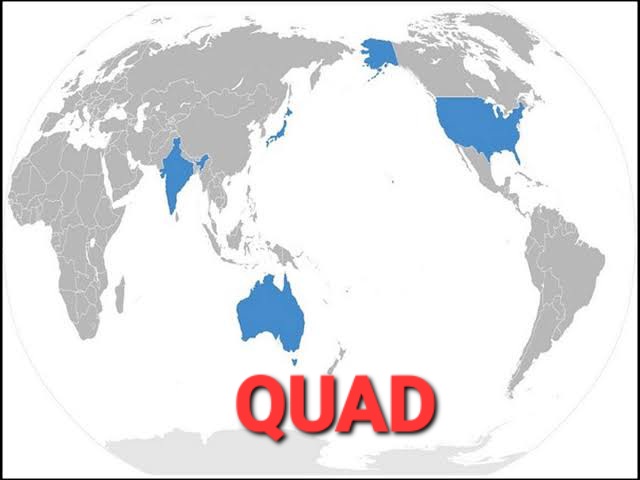
The QUAD members expressed their collective concerns on the ongoing conflicts such as Ukraine, Middle-East, and Myanmar.
To know about Myanmar’s history, political and tribal details, link from archives is given below – From Archives – https://mutgikar.wordpress.com/2024/07/29/myanmar-archives/
The link to the detailed QUAD Meeting News is given below ⬇️
 the-curators.org
Leave a comment