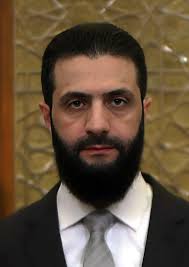
al-Sharaa’s New Syria
A big game changer in the West Asia.
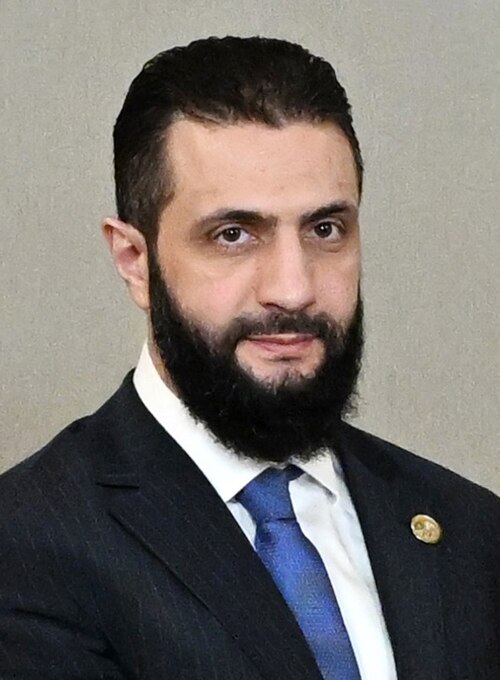
A tall, lanky, and enigmatic Saudi Arabian youth from Damascus left home to join Iraqi resistance against the US invasion of Iraq in 2003 and become untraceable to his parents and friends who assume him dead. But he was alive, fighting in Iraq soon to be caught by the US, and Iraqi forces combine search operations for foreign terrorists. He was jailed and came in contact with al-Qaeda and ISIS, formed a Syrian branch, daringly breached ties with both, formed a ruthless, literally parallel government in north Syria with UN, US declaring him wanted and his group- ‘A terrorist outfit’ and then in a lightning strike his group make Syrian president al-Assad flee the country to become president of Syria! Meet al-Sharaa, the present interim president of Syria!
In his childhood, al-Sharaa was studious, quiet, brilliant, and a deeply religious student. Prevailing geopolitics in the unstable Middle- East, Palestine issue, and increasing bigotry and fanaticism in the surroundings were shaping his perspective. In his early youth, He left Syria to join the Iraqi resistance movement to the US invasion and then became untraceable. His Syrian Sunni parents and friends feared he was dead. But it wasn’t so !
Once in Iraq, the young man rose in the ranks of an anti US Iraqi outfit but later on arrested and jailed by US and Iraqi army soldiers who were searching for foreign fighters. He was sent to the Camp Bucca jail, literally a ‘factory of terrorists’. Camp Bucca is a US detention center where foreign mercenaries and other fighters – terrorists were put together.
Camp Bucca was like a radicalization center. He utilized his time in the detention camp studying the geography and topography of Syria. from 2006 to 2011 he was at camp Bucca. The camp was filled up by other terrorists and disgruntled ex Iraqi soldiers .Here he soon came in close contacts with other radicals. Many of his camp-mates were members of terrorist outfits like al-Qaeda and ISIS. Abu Bakr al Baghdadi, who later on became the chief of ISIS, was also leading terrorists in the camp. al-Sharaa soon became a confidant and entered into a selected group of terrorists forming a close coterie around al Baghdadi.
Until now, this can be a journey of any jihadist and misled terrorist who then, say, crippled in an ambush or infighting and lost or dead! This is where Al-Sharaa differs. He survived and released from the camp. As a trusted hand of al Baghdadi and other chief members of terrorist outfits, his role was already decided in the meetings with al- Qaeda. He was entrusted with the task of establishing al-Qaeda presence in Syria.
This led to the formation of al-Nusra front in 2012. al-Baghdadi provided monetary aid, manpower and strategic guidance. This ISIS branch was started with a monthly payment of 65000 to 70000 dollars from the main branch. al-Sharaa’s role was to induct young men into the violent world of jihadists. They all wanted to turn the tide of time and bring back the Sharia – the ancient law of Islam.
Al-Sharaa ran the operations with his phenomenal convincing powers and trained innocent young men to all sorts of warfare and even suicide bombing. People praise his convincing powers but forget for what purpose these powers put in use. There were more than 600 terrorist attacks in Syria in the first year itself, making al-Sharaa’s outfit notoriously famous.
Ahmed Hussein al-Sharaa has come a long way indeed. But this can be a story of any Muslim boy in the Middle East in these chaotic geopolitical international times. The infamous terror outfits like al-Qaeda or ISIS have well run operation systems with a lot of money, proper propaganda, and recruitment. They ran like a well-oiled commercial corporate with branches and branch heads managing the business of you know what. The bold and talented Syrian youths were brainwashed with a lure of money, power, and fame. A lethal admixture that made them blow self with bombs strapped to their body.
Al-Nusra’s formative years saw it engaged in fierce battles with Syrian Assad’s armed forces and busy in establishing dominance of Sharia with strict interpretation and execution of Islamic law. This raised concerns in international bodies and the minority groups. about al-Nusra and its intentions. Al-Nusra was soon declared a terrorist outfit by the UN and countries like US, and UK. But, here al-Sharaa’s upbringing, his own interpretation of history and religion become evident, and he managed to change course in time.
In 2013, the ISIS supremo and self-declared Caliph al-Baghdadi made a sudden and unilateral announcement. He declared the merger of the Islamic State of Iraq with al-Nusra Front to form the Islamic State of Iraq and the Levant – ISIL, later known as ISIS. This audacious move was a direct attempt to absorb al-Nusra into its folds and to establish absolute authority over all jihadist operations in Syria.
Al- Sharaa vehemently rejected the declaration and defied al-Baghdadi, publicly denouncing the merger and reaffirming his group’s allegiance directly to Ayman al-Zawahiri, the then-leader of al-Qaeda. This marked a profound and public schism between the two most powerful jihadist factions in Syria. Al-Sharaa sought to distance al-Nusra from ISIS’s increasingly brutal and indiscriminate tactics, which were alienating many local Syrians.
The split led to open warfare between al-Nusra Front and ISIS, with al-Nusra often fighting alongside other rebel groups to expel ISIS from Syrian territories. This strategic evolution marked al-Sharaa’s trajectory. In a calculated move to garner broader international support and legitimacy, he publicly disavowed al-Qaeda in 2016, reforming his group into Hayat Tahrir al-Sham (HTS). This shift represented a crucial pivot from transnational jihadism to a more localized, governance-focused approach within Syria.
He began to present a more moderate image, engaging in public discourse and even granting interviews to different publications, emphasizing his commitment to protect Syria’s diverse minorities and building a functional state.
The decisive turning point arrived in Dec.2024, when the HTS led coalition launched a lightning offensive that shattered the Assad regime’s long-held grip on power. This swift military victory, which saw the Syrian president Bashar al-Assad fleeing Syria, catapulted al-Sharaa into the highest office.
In January, he was formally appointed as president of Syria for a transitional period, marking an astonishing transformation of a fonce designated terrorist by the US to president of Syria to shake hands with the US president Donald Trump.
This of course not the pleasant end of the story. The real story is just beginning. With rival groups and old enemies like ISIS baying for his blood, the new president must tread the middle path with great courage and patience. Once an ISIS, al-Qaeda man now joining arch enemy state of US and negotiating with Israel is hardly digestible for the hard-boiled fighter groups. And, the ISIS, which was driven out of Syria, started to attack him. Israel is not happy with his proximity to Turkey, though Turkey and Saudi Arabia were instrumental in arranging a meeting with the US president Trump and lifting sanctions on Syria.
Rise of al-Sharaa created a huge geopolitical shift and its effects are started to reverberate all over. His rise waned the Iranian and Russian power in the region. Syria is a patchwork of different groups with different ideologies. The unexpected stance of al-Sharaa government to support minorities, freedom of expression, and acknowledgment of rights of women can turn his old friends into foes. Such a situation may provide a fertile ground for terror groups and can plunge Syria in a more severe situation. To avoid such turn, Al-Sharaa has merged mercenaries and other fighters into the Syrian army. A move that can turn the tables on him anytime. The inclusion of Uyghurs fighters from China into the Syrian army can also make China rethink its role in the region. Many Uyghurs are associated with the Turkistan Islamic Party. ISIS will also try to avenge its expulsion from the area and is already attacking Syrian forces. It may rejuvenate its presence in Syria. Syria may become a new hub for foreign mercenaries, fighters, and terrorists. Israel, though stated to have contacted al-Sharaa several times, attacked south Syria when two rockets launched from Syrian land falls into its territory. A huge number of Syrians displaced earlier are returning back to their mainland in the hope of return of normalcy, can strain the new economy.
India should establish good relations with the new Syrian government. Syria’s opinion in OIC (Organization of Islamic Cooperation) countries or UN is important. Syria may become a new hub for foreign mercenaries, fighters and terrorists and a possible launch pad against India. Turkey’s anti India stand on Kashmir is evident on many occasions. Also, it supplied drones and other arms to attack India in the recent Indo Pak war over Pehelgam terror attack. Syria and Turkey are enjoying very close relations, a fact that cannot be overlooked by India.
 the-curators.org
Leave a comment