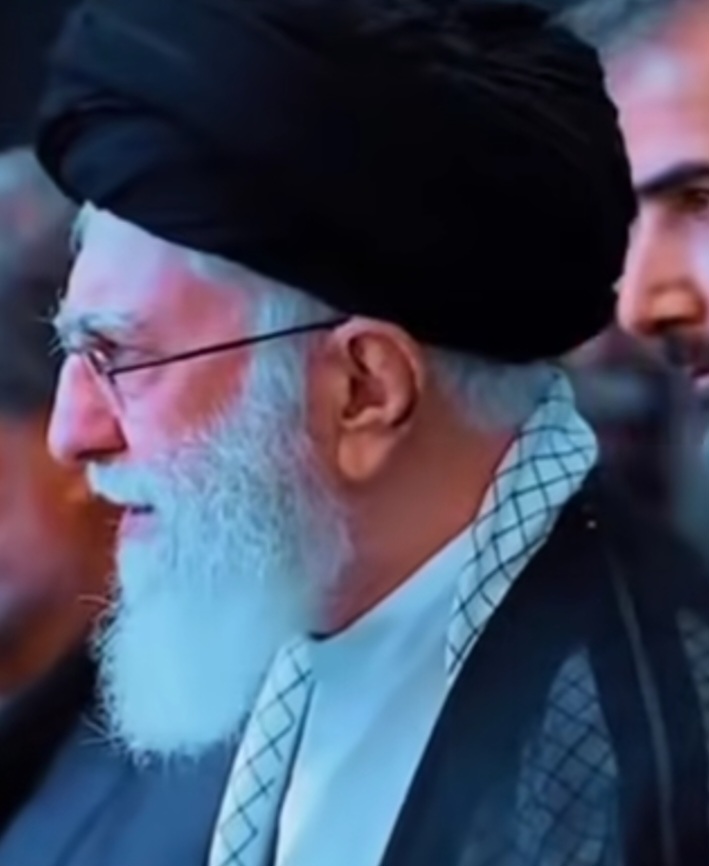
In the narrow, sun-drenched alleys of Mashhad, there once lived a boy who understood the weight of silence before he understood the weight of a crown. To look at Ali Khamenei “humanly” is to see a man woven from two clashing threads: the delicate silk of Persian poetry and the cold iron of revolutionary survival.
The Boy of the One-Room House
& a childhood defined by an “exalted poverty.” His father, a silent and stoic cleric, modeled a life where worldly goods were distractions.
Young Ali lived in a house so small that a single guest meant the family had to retreat to the basement. There was a dignity, a sense that the spirit was fed while the stomach was not.
It was his mother, who provided the “fluidity” in his early life. While his father taught him the rigid structures of Islamic jurisprudence, his mother opened the doors to the world’s imagination. She narrated the histories of kings and the verses of Hafez.
He was a voracious reader and had his own views and perhaps this stands in contradiction that the man who would eventually ban “Western decadence” spent his youth under a kerosene lamp devouring Victor Hugo’s Les Misérables.
As he grew, the scholar’s robe became his armor. In the 1960s, he wasn’t just a cleric; he was an intellectual rebel. He frequented the literary “café culture” of Mashhad, debating poetry as fiercely as theology. But the “human touch” of those years was soon calloused by the reality of the Shah’s prisons.
The turning point of his physical life occurred in 1981. A bomb, hidden in a tape recorder—an instrument of voice and music—shattered his right side. He survived, but his right arm was rendered a lifeless pendulum. From that moment on, he became a “Living Martyr.” To his followers, he was a man who had literally given his flesh for the faith; to his detractors, the injury symbolized a leader whose right hand (the hand of mercy and creativity) had been stilled.
He took a fractured, post-revolutionary state and turned it into a regional fortress. Iran reached for the stars through its space program and deep into the atom through its nuclear labs. He spoke of “Dignity” (Ezzat) as the highest virtue of a nation. To him, the “Axis of Resistance” —a way for the East to finally stand tall against the West.
However, the “fluidity” he cherished in literature did not translate practically in the governance. As the decades passed, the gap between ‘Ideal’ and ‘Economic Reality’ widened into a chasm.
The mandatory veil—the Burqua and Hejab—became the physical border of his authority. When the women of Iran rose up, chanting for “Life” and “Freedom,” they were asking for the very fluidity he had once found in the novels of his youth. Instead, they met the “Iron Fist” of a man who believed that to bend was to break.
The Final Verse
By the time of his passing on February 28, 2026, he had become a monument—imposing, unyielding, and increasingly isolated. He lived long enough to see the “Resistance Economy” result in empty tables and the “Cultural Revolution” result in a youth that felt more alienated than ever.
In his worldview, the Hejab (veil) was never just a piece of cloth; it was a “frontier” against Western cultural invasion.
The 2022 Spark against his tenure was provided in the form of the death of Mahsa Amini in the custody of the ‘Morality Police’, ignited the “Woman, Life, Freedom” movement. Khamenei famously dismissed the protests as a “plot” by the US and Israel.
He argued that removing the veil would lead to the collapse of the Iranian family unit. The state responded with “Revolutionary Court” executions and the use of facial recognition technology to fine women in cars or malls who were “unveiled.” This created a deep, silent resentment that moved from the streets into households
While the world focused on the veil, the Iranian “street” was also screaming about the Economy of Resistance in the form of severe inflation.
By 2024-2025, inflation on basic food items often exceeded 50-70%. His refusal to compromise on the nuclear program meant the Rial (Iran’s currency) continued its “death spiral.” & While the public was told to live “ascetically,” reports of massive wealth amassed by government and cleric system leaked out.
 the-curators.org
Leave a comment